 Elizabeth Davidson · · 5 min read
The Oswego Iron Furnace in George Rogers Park: Lake Oswego's Iron Story
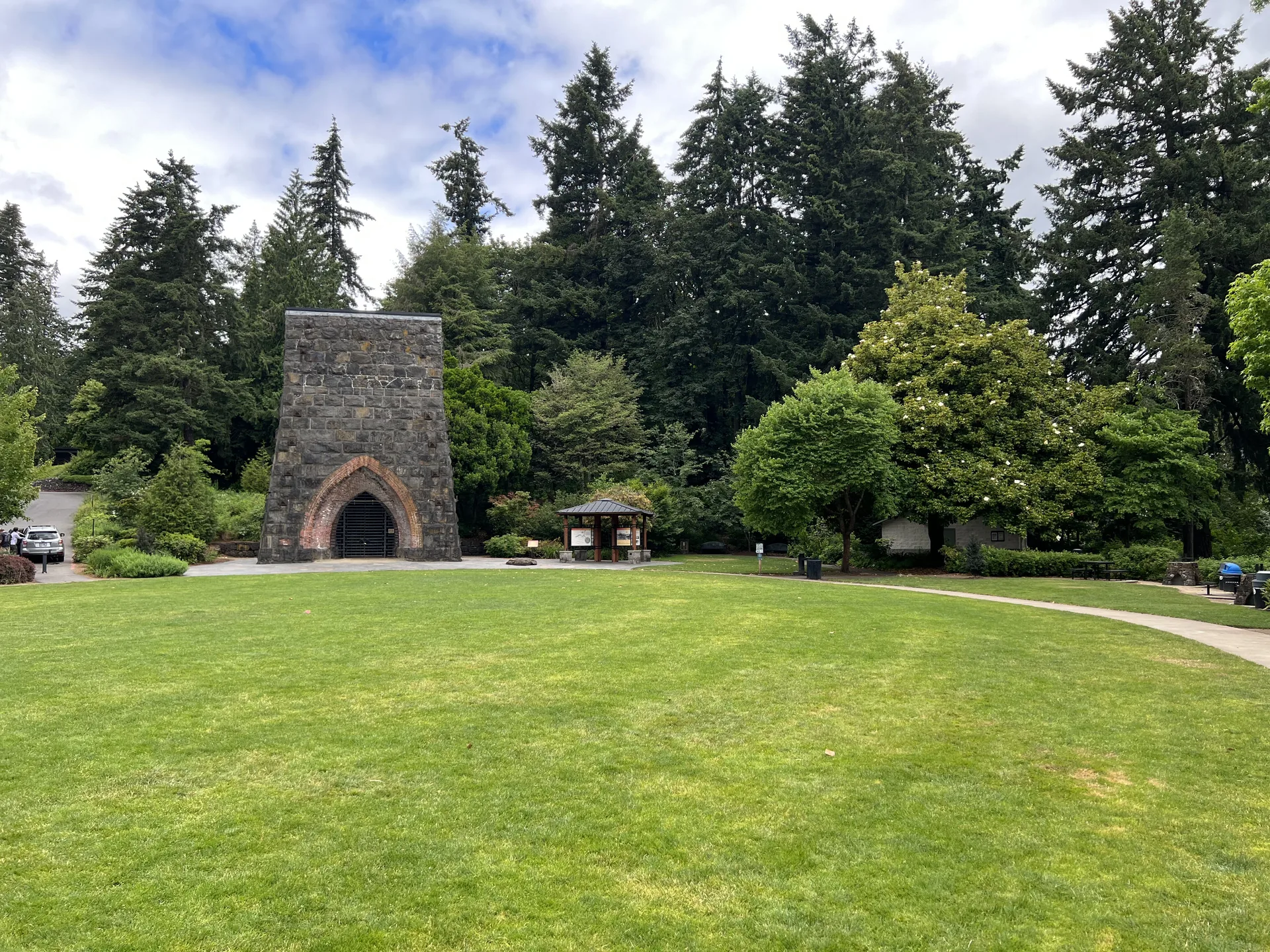
Every time I walk down into George Rogers Park, I stop at the big stone furnace by the river. It looks like a castle tower that wandered off, but it's actually the reason the little town of Oswego was replatted in 1867, in anticipation of new residents coming to work in the iron industry. On August 24, 1867, the Oregon Iron Company poured its first pig of iron here, and iron was made in Oswego for about three decades, here and later at a second furnace downstream. Today the furnace is the only piece of that whole complex still standing, and it's one of my favorite bits of local history to share.
Quick facts
- What it is: a stone blast furnace hewn from basalt from a local quarry, built by the Oregon Iron Company
- Built: 1866-1867; first pig iron poured August 24, 1867
- Architect: G.D. Wilbur, as listed in the National Register record
- Designation: National Register of Historic Places (NRIS 74001674, record dated February 12, 1974)
- Where: George Rogers Park, where Oswego Creek meets the Willamette River
- Lifetime output of Oswego's iron industry: 93,404 tons of pig iron
How an iron town began
In 1865, investors William S. Ladd, H.C. Leonard and Henry D. Green founded the Oregon Iron Company to make pig iron from Oswego's ore. Construction of the blast furnace began in 1866. The town was getting ready, too: on January 10, 1867, John Trullinger replatted Oswego in anticipation of new residents coming to work in the iron industry, and the Lake Oswego Preservation Society notes that the 1867 plat included street names honoring iron industry investors.
The furnace was the first one built in Oswego. It was once part of a large pig-iron manufacturing complex, and today all the other buildings are gone. That's what makes standing next to it feel so special: it's the one survivor.
Ore, ox carts and a little railroad
The iron didn't start at the river. The largest source of ore was the Prosser iron mines on the side of Iron Mountain, mined between 1865 and 1894. In 1867 a mine road, one of Oswego's oldest roads, was built across the southern face of Iron Mountain, and ox carts hauled ore along it until a narrow-gauge railroad replaced them.
The business changed hands more than once. In 1877 the Oregon Iron Company was sold at a sheriff's auction to Samuel Brown and Ernest Crichton for $38,612. The new Oswego Iron Company, formed in 1878, raised the stone furnace by 10 feet, increasing its capacity from a daily average of 8 tons of pig iron to 11 tons, and built a 2.6-mile railroad to the Iron Mountain mines. In 1882 the company, heavily in debt, was sold to its investors Simeon Reed and Henry Villard, who reorganized it as the Oregon Iron & Steel Company.
The boom years and the end
Oregon Iron & Steel completed a modern new blast furnace downstream on the Willamette in 1888. Iron production peaked in 1890, when the new furnace made 12,305 tons of pig iron, more than in any earlier year, and the company employed more than 325 workers. That same year the Odd Fellows Hall went up in Old Town, and it's now one of the oldest buildings remaining in Lake Oswego.
Then the market turned. Falling demand for iron and the depression of 1893-1897 closed the blast furnace in 1894, and it never reopened. Over its whole history, Oswego's iron industry produced 93,404 tons of pig iron, more than any other iron smelter west of the Rocky Mountains.
Seeing the iron story today
The furnace sits in the lower part of George Rogers Park, and the city says one of the best Willamette River views is near it. The city lists ADA parking and restrooms among the park's amenities.
If you want to keep going, the furnace is one of seven stops on the Oswego Iron Heritage Trail, a walking route on existing streets and pathways with interpretive signs at each site. The stops are:
- the 1866 furnace in George Rogers Park
- the 1888 furnace site in Roehr Park
- the pipe foundry site in Foothills Park
- the Prosser iron mines in Iron Mountain Park (the tunnels are no longer accessible) and the Iron Mountain Trail, which follows the old ore-railroad bed
- a charcoal pit in Tryon Creek State Park
- the Iron Workers' Cottage on Wilbur Street
- the Oswego Pioneer Cemetery
The Iron Workers' Cottage Museum at 40 Wilbur Street is my favorite add-on. It's likely one of the 100 homes the Oregon Iron & Steel Company built for employees between 1882 and 1884, and the Preservation Society calls it the last remaining intact residence from the iron era. The museum is open Saturdays from 11 a.m. to 3 p.m. (unless it's a holiday), and admission is free. Three parking spaces, one of them ADA, are reached from the alley behind the museum.
For more ideas in the same corner of town, my fall guide to Lake Oswego includes the trails at George Rogers Park, and you'll find all my posts about the city on my Lake Oswego city guide page.
Lake Oswego business of the week
After a walk along the Iron Heritage Trail, a warm meal sounds just right. A favorite of mine is Gubanc's Restaurant, a long-running bar serving from-scratch pub fare and draft brews in a warm, contemporary interior. You'll find it at 16008 Boones Ferry Rd, Lake Oswego, OR 97035.
Frequently asked questions
When did the Lake Oswego iron furnace first make iron? The Oregon Iron Company made its first pig of iron on August 24, 1867, the start of Oswego's iron industry.
Where is the iron furnace? In George Rogers Park, where Oswego Creek meets the Willamette River.
Is the furnace on the National Register of Historic Places? Yes. It's listed as NRIS 74001674, with a record dated February 12, 1974.
How much iron did Oswego produce? A total of 93,404 tons of pig iron between 1867 and 1894, more than any other iron smelter west of the Rocky Mountains.
I love sharing the stories behind the places we walk past every day. If you're curious about living in Lake Oswego, I'd be glad to hear from you and help you get to know it.
Sources
- National Park Service NPGallery: Oregon Iron Company Furnace record
- National Register nomination, Iron Workers' Cottage (iron industry history)
- National Register nomination, Odd Fellows Hall
- City of Lake Oswego: George Rogers Park
- City of Lake Oswego: Oswego Iron Heritage Trail
- Lake Oswego Preservation Society: Iron industry history
- Lake Oswego Preservation Society: 1850 Oswego
- Lake Oswego Preservation Society: 1926 Forest Hills expansion
- Lake Oswego Preservation Society: Iron Workers Cottage Museum
- Gubanc's Restaurant
Thinking about buying or selling in Portland or Lake Oswego? Let's talk.
Contact Elizabeth